Introduction
Children are born learning. Their early health, development, and learning experiences build the foundation for overall well-being and future success in school. This foundation is strongest when children experience warm, responsive, and secure relationships with their caregivers and teachers, and when they feel a sense of belonging.
Teaching and caregiving are challenging, dynamic careers that come with many responsibilities. Early childhood educators need to understand children’s lives and how they think and learn. At the same time, they manage multiple goals simultaneously and integrate multiple sources of information. To meet the needs of all children and families, early childhood educators need a wide-ranging set of competencies.
What are competencies?
Competencies describe what early childhood educators need to know (knowledge), be able to do (skills), and the attitudes and behaviors (dispositions) they should have. Core competencies explain what educators should understand about children and learning, habits and approaches they should use, and values they should bring to their work. The competencies focus on practice, meaning they can be observed, demonstrated, and assessed in educators’ everyday work.
Core Body of Knowledge
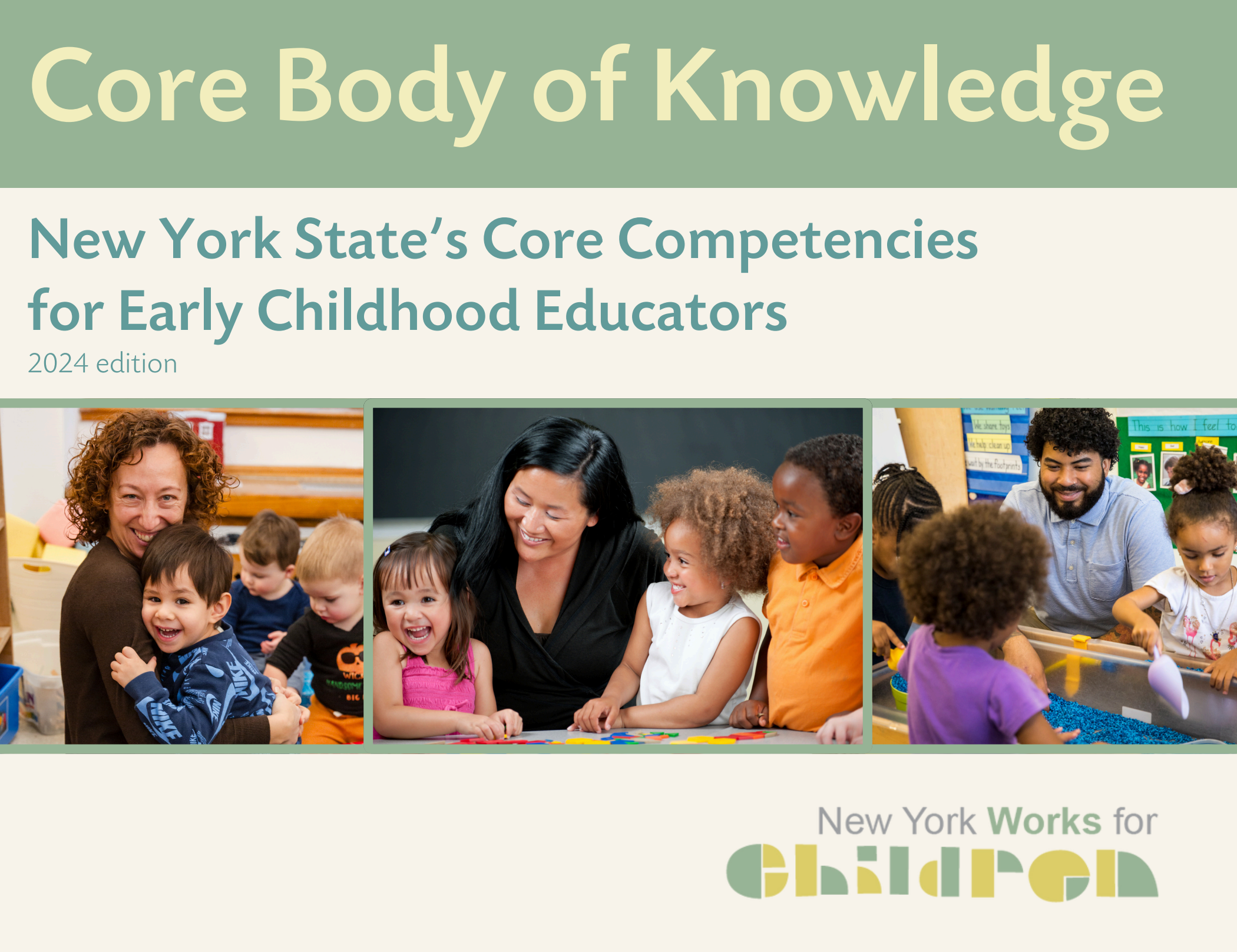
New York State has created a set of competencies for the early childhood education workforce. These competencies are outlined in a document called the Core Body of Knowledge (CBK). Updated in 2024, the CBK describes the knowledge and skills needed to be an effective early childhood educator. Policymakers and program developers use the CBK to guide and align professional development for early childhood professionals who work with young children from birth through age 8 across different settings, roles, and sectors.
DownloadPrimary Competencies
New York developed these Primary Competencies for Early Childhood Educators to accompany the 2024 Core Body of Knowledge.
The Primary Competencies for Early Childhood Educators are written specifically for practitioners who work with young children, birth through age 8. They are meant to serve as a resource for those who work directly with children and families, including child care providers, assistant teachers, teachers, and program leaders.
This document organizes the content of the revised Core Body of Knowledge: New York State’s Core Competencies for Early Childhood Educators 2024 Edition into nine primary competencies, which arrange the essential capabilities needed for effective early childhood caregiving and teaching into an easy-to-remember structure.
How the Primary Competencies Are Organized
The primary competencies are organized into three broad categories:
Professional Knowledge
What early childhood educators KNOW about how children develop and learn
Effective teaching begins with an understanding of how children develop and learn. Early childhood educators understand how children develop skills and abilities, including their physical, social, emotional, cognitive, and language development; and how they learn in content areas, including literacy, math, science, social studies, technology, and the arts. Professional knowledge helps educators make decisions about how to care for and teach young children.
Early childhood educators:
Professional Practice
What early childhood educators DO with their knowledge of child development and learning
Effective teaching involves putting knowledge into action. Early childhood educators use their knowledge to create safe, supportive learning environments; organize space, materials, schedules, and routines; observe and keep track of children’s development; and plan meaningful learning experiences. Professional practice helps children feel supported and ready to learn.
Early childhood educators:
Professional Engagement
HOW early childhood educators work with others and keep improving
Effective teaching also involves building strong relationships with colleagues and families. Early childhood educators collaborate with families, colleagues, and community partners to do their best work for children. Regular reflective inquiry helps early childhood educators apply their learning and continue growing professionally. Professional engagement helps educators improve their practice.
What Each Competency Section Includes
- A brief overview explaining how the competency supports caring for and teaching young children.
- Reflection questions to help educators think about their own work as they read.
-
Three parts describing what educators need to be effective:
- Things to Know: Key information and understanding
- Skills to Build: Abilities educators use in their daily work
- Habits of Mind and Dispositions: Values, attitudes, and ways of thinking that support good practice
-
Focus Areas, which identify the major topics, skills, and practices within each primary competency.
- Each focus area includes practice examples of actions, behaviors, and skills that help educators see what effective practice looks like and consider where and how they might grow. Practice examples are arranged progressively to help educators see how practice can become more sophisticated over time.
About the Practice Examples
The practice examples within each focus area are grouped into progressions that show how practice can change over time. Groupings show a path of growth from basic to more advanced practice as educators spend more time in early childhood settings and gain knowledge, skills, and experience.
Over time, educators often move from being “directive” (telling children what to do) to facilitative (guiding children, encouraging choice and independence), and then to collaborative (working alongside children and families and helping them set their own goals, especially with older children).
More sophisticated practices require self-awareness and reflection; cooperation, collaboration, and problem-solving skills; the ability to consider different contexts and perspectives; and technical skills developed through education, training, and experience. As practice becomes more complex, educators often use several skills together.
Practice examples are listed in a general order from simpler to more complex to help educators think about what to focus on in their professional learning. The progressions are intentionally not labeled with names like “beginner” or “intermediate,” and educators do not move through them in a fixed or linear way. Dashed lines between groupings are meant to show that they are fluid, and the practice examples within each grouping do not include every possible skill.
This table provides a general description of each progression level.
| Level | At this level, behaviors and skills require: |
|---|---|
| 1 |
|
| 2 |
|
| 3 |
|
| 4 |
|
Practice Examples ARE
- Grouped to show a general progression from basic to advanced practice
- Indicators of what effective teaching looks like
- Prompts to help educators reflect and identify areas for growth
Practice Examples ARE NOT
- Concrete measurements of educator growth
- Descriptions of role-specific job expectations
- Tools for evaluation
Key Themes
Several key themes appear across the nine primary competencies, including ways to support children who are managing stress and adversity; strategies for supporting children’s social-emotional development; general learning competencies, like executive function skills; and strategies for teaching academic content. The primary competencies also incorporate the principles of Universal Design for Learning (UDL) and other strategies to ensure all children can access and participate in learning experiences.
How to Use the Primary Competencies
Caring for and teaching young children is complex work. Educators build their skills over time through experience, reflection, feedback, and professional learning. This growth does not happen in a straight line.
The primary competencies are designed to be a tool for learning and growth. They help educators understand what effective practice looks like and think about how they want to strengthen their own work. Educators can read the practice examples and reflect on which practices they already use and which ones they want to develop next. This reflection is meant to support learning, not to evaluate performance.
Educators can use the primary competencies in several ways:
- Review all nine primary competencies to get a broad picture of effective practice
- Concentrate on a single primary competency and reflect on the focus areas within it
- Consider the practice examples within a single or just a few focus areas in relation to their own practice
- Use the primary competencies alongside self-assessment and professional development planning tools
Based on their own self-reflection and assessment, educators can then create a personalized learning plan with goals for growth, such as building new skills, deepening knowledge, or trying new approaches.
The primary competencies can also support program leaders, colleagues, and coaches as they offer feedback and guidance to teachers and caregivers. Importantly, because the practice example progressions do not represent fixed levels of performance or job expectations, they should not be used for formal evaluation.
New York State Early Learning Guidelines
The Primary Competencies can also be used alongside the New York State Early Learning Guidelines as a complementary resource to support high-quality practice. The Early Learning Guidelines help educators understand how children grow and develop and show ways to support that growth through family engagement, learning environments, and intentional interactions and activities. Educators can use the Guidelines to plan caregiving and teaching. The Primary Competencies describe the knowledge, skills, and dispositions educators need to support children’s learning and development. They help educators reflect on their practice across nine key areas and can be used to guide decisions about professional development. Together, these documents help educators connect how children develop with effective caregiving and teaching practices.